

“A peasant that reads is a prince in waiting.” – Walter Mosley, The Long Fall

At Dark, I Become Loathsome by Eric LaRocca
fiction / horror.
 “If you’re reading this, you’ve likely thought that the world would be a better place without you.”
A single line of text, glowing in the darkness of the internet. Written by Ashley Lutin, who has often thought the same—and worse—in the years since his wife died and his young son disappeared. But the peace of the grave is not for him—it’s for those he can help. Ashley has constructed a peculiar ritual for those whose desire to die is at war with their yearning to live a better life.
Struggling to overcome his own endless grief, one night Ashley finds connection with Jinx—a potential candidate for Ashley’s next ritual—who spins a tale both revolting and fascinating. Thus begins a relationship that traps the two men in an ever-tightening spiral of painful revelations, where long-hidden secrets are dragged, kicking and screaming, into the light.
Only through pain can we find healing. Only through death can we find new life.
“[A] stunning, immersive, and relatable tale about the unbearable anguish of grief… LaRocca gives readers an unforgettable protagonist, a complicated man who will repulse them at first but will ultimately steal their hearts.” – Becky Spratford, Library Journal, STARRED REVIEW
“…haunting… With claustrophobic rituals and spine-tingling horror you won’t be able to look away from, this is LaRocca at his best.” – Isabelle McConville, B&N Reads
“Eric LaRocca does it again with a most disturbing tale that is beautifully written in his unique hand. The language is lush but dark, the characters are whole but broken, and the story is like nothing you’ve read before.” – Alex C .Telander, Chicago Book Review


Been Wrong So Long It Feels Like Right by Walter Mosley
fiction / mystery / suspense.
 Joe King Oliver’s beloved Grandma B has found a tumor, and at her age, treatment is high-risk. She’s lived life fully and without regrets, and now has only a single, dying wish: to see her long-lost son. King has been estranged from his father, Chief Odin Oliver, since he was a young boy. He swore to never speak to the man again when he was taken away in handcuffs. But now, Grandma B’s pure ask has opened King’s heart, and through his hunt, he gains a deeper understanding of his father as a complicated, righteous man—a man defined by women, a man protected by women, a man he wants to know. Although Chief was released from prison years ago, he’s been living underground ever since. Now, King must not only find his father, but prove his innocence, and protect the future of his entire family.
Simultaneously, King finds himself in a moral bind. Marigold Hart, the wife of a powerful Californian billionaire, has gone missing, along with their seven-year-old daughter. Orr is brutish and dangerous, and King realizes after locating her that it’s in her best interest to stay hidden. But are his motives pure? There is something magnetic about Marigold; he can’t help but want her near.
In the latest installment in the Joe King Oliver series, no good deed goes unpunished. Emotionally stirring, pulse-pounding, and undeniably sexy, Been Wrong So Long It Feels Like Right shows Walter Mosley at his best.
“For fans of ex-police detectives turned PIs and family dramas!” – Jamie Canaves, Book Riot
“A gritty crime novel with a pace that never lets up; Mosley’s best work since the incomparable Easy Rawlins series.” – David Keymer, Library Journal, STARRED REVIEW
“…smooth [and] enjoyable… series fans will enjoy themselves.” – Publishers Weekly
Black in Blues: How a Color Tells the Story of My People by Imani Perry ★
nonfiction / history / art / politics / sociology.
 Throughout history, the concept of Blackness has been remarkably intertwined with another color: blue. In daily life, it is evoked in countless ways. Blue skies and blue water offer hope for that which lies beyond the current conditions. But blue is also the color of deep melancholy and heartache, echoing Louis Armstrong’s question, “What did I do to be so Black and blue?” In this book, celebrated author Imani Perry uses the world’s favorite color as a springboard for a riveting emotional, cultural, and spiritual journey—an examination of race and Blackness that transcends politics or ideology.
Perry traces both blue and Blackness from their earliest roots to their many embodiments of contemporary culture, drawing deeply from her own life as well as art and history: The dyed indigo cloths of West Africa that were traded for human life in the 16th century. The mixture of awe and aversion in the old-fashioned characterization of dark-skinned people as “Blue Black.” The fundamentally American art form of blues music, sitting at the crossroads of pain and pleasure. The blue flowers Perry plants to honor a loved one gone too soon.
Poignant, spellbinding, and utterly original, Black in Blues is a brilliant new work that could only have come from the mind of one of our greatest writers and thinkers. Attuned to the harrowing and the sublime aspects of the human experience, it is every bit as vivid, rich, and striking as blue itself.
“An innovative cultural history.” – Kirkus Reviews, STARRED REVIEW
“[A] meditative and healing introspection on Black history presented through a fresh and innovative lens… Innovative, melancholic and expansive, Black in Blues achieves its goal to bring Black history to life.” – Leah Tyler, Atlanta Journal-Constitution
“Black in Blues is clearly a learned work — it is full of archival gems — but it is also a lyrical one… a contrapuntal document, musical and moving, and no less rich for its tumbling abundance. In place of clear conclusions are persistent themes, like recurring notes in a song.” – Becca Rothfeld, Washington Post
“In direct and intimate prose, Perry synthesizes an impressive range of research into a sinewy, pulsing narrative that positions the past as an active, living force in the present. Readers will be swept up.” – Publishers Weekly, STARRED REVIEW
The Crash by Freida McFadden
fiction / suspense / mystery.
 The nightmare she’s running from is nothing compared to where she’s headed.
Tegan is eight months pregnant, alone, and desperately wants to put her crumbling life in the rearview mirror. So she hits the road, planning to stay with her brother until she can figure out her next move. But she doesn’t realize she’s heading straight into a blizzard.
She never arrives at her destination.
Stranded in rural Maine with a dead car and broken ankle, Tegan worries she’s made a terrible mistake. Then a miracle occurs: she is rescued by a couple who offers her a room in their warm cabin until the snow clears.
But something isn’t right. Tegan believed she was waiting out the storm, but as time ticks by, she comes to realize she is in grave danger. This safe haven isn’t what she thought it was, and staying here may have been her most deadly mistake yet.
And now she must do whatever it takes to save herself—and her unborn child.
“[The] brisk pacing and frequent cliffhangers make it easy to wolf down in a single sitting. McFadden’s fans will enjoy themselves.” – Publishers Weekly
“[An] intense, breathtaking, twisted thriller with a shocking ending no one will be able to predict… Fans are going to devour this one in one sitting as I did.” – Sandra Hoover, Mystery & Suspense
Everything Must Go: The Stories We Tell About the End of the World by Dorian Lynskey
nonfiction / history / politics / philosophy.
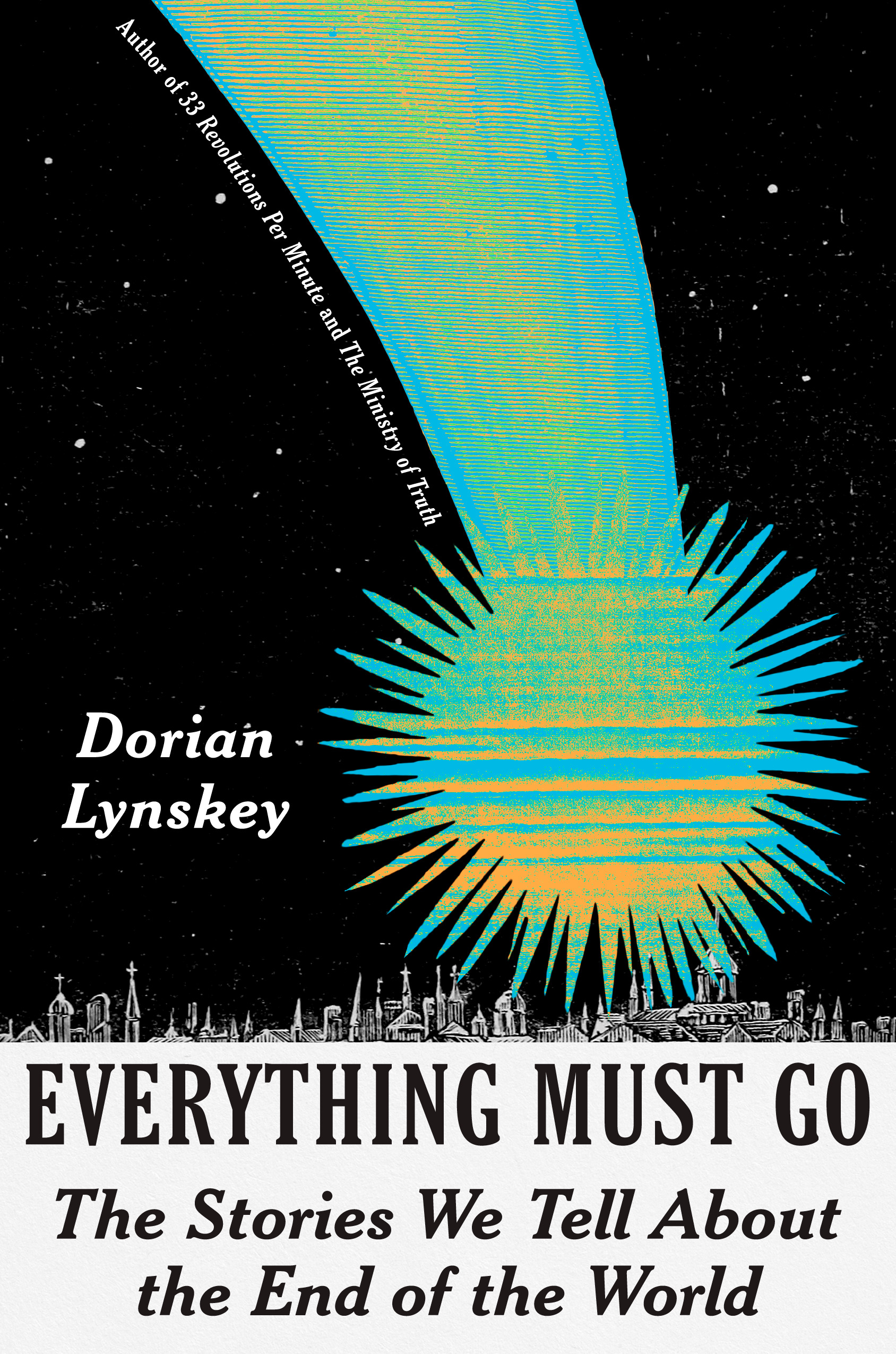 As Dorian Lynskey writes, “People have been contemplating the end of the world for millennia.” In this immersive and compelling cultural history, Lynskey reveals how religious prophecies of the apocalypse were secularized in the early 19th century by Lord Byron and Mary Shelley in a time of dramatic social upheaval and temporary climate change, inciting a long tradition of visions of the end without gods.
With a discerning eye and acerbic wit, Lynskey examines how various doomsday tropes and predictions in literature, art, music, and film have arisen from contemporary anxieties, whether they be comets, pandemics, world wars, the Cuban Missile Crisis, Y2K, or the climate emergency. Far from being grim, Lynskey guides readers through a rich array of fascinating stories and surprising facts, allowing us to keep company with celebrated works of art and the people who made them, from H.G. Wells, Jack London, W.B. Yeats and J.G. Ballard to The Twilight Zone, Dr. Strangelove, Mad Max and The Terminator.
Prescient and original, Everything Must Go is a brilliant, sweeping work of history that provides many astute insights for our times and speaks to our urgent concerns for the future.
“…clever and voluminous… Everything Must Go is so engagingly plotted and written that it’s a pleasure to bask in its constant stream of remarkable titbits and illuminating insights.” – Fara Dabhoiwala, The Guardian
“Lynskey’s astute analysis excels at teasing out the existential concerns that have animated artists over the course of millennia. Readers won’t want this to end.” – Publishers Weekly, STARRED REVIEW
“Lynskey, a British cultural journalist, has the kind of omnivorous sensibility essential for a project like this… Lynskey also happens to be a terrifically entertaining writer, with a requisite sense of gallows humor… Amid all the plotting pyrotechnics he recounts in this book, it’s the small human details that move Lynskey most.” – Jennifer Szalai, New York Times
Good Dirt by Charlaine Wilkerson ★
fiction / historical fiction.
 When ten-year-old Ebby Freeman heard the gunshot, time stopped. And when she saw her brother, Baz, lying on the floor surrounded by the shattered pieces of a centuries-old jar, life as Ebby knew it shattered as well.
The crime was never solved—and because the Freemans were one of the only Black families in a particularly well-to-do enclave of New England—the case has had an enduring, voyeuristic pull for the public. The last thing the Freemans want is another media frenzy splashing their family across the papers, but when Ebby’s high profile romance falls apart without any explanation, that’s exactly what they get.
So Ebby flees to France, only for her past to follow her there. And as she tries to process what’s happened, she begins to think about the other loss her family suffered on that day eighteen years ago—the stoneware jar that had been in their family for generations, brought North by an enslaved ancestor. But little does she know that the handcrafted piece of pottery held more than just her family’s history—it might also hold the key to unlocking her own future.
In this sweeping, evocative novel, Charmaine Wilkerson brings to life a multi-generational epic that examines how the past informs our present.
“The author of the hit 2022 novel Black Cake has another winner…” – Christina Ianzito, AARP
“Through a treasured heirloom pottery jar, the novel chronicles the history of Ebby’s family and its resilience.” – Alison Zaya, Library Reads, TOP PICK JANUARY 2025
“The narrative was deeply compelling and the plot pacing kept me engaged while giving time for character development.” – Jocelyn, Write Through the Night
“[A] remarkable achievement… deeply moving… Wilkerson has created a work that is both timely and timeless, offering readers a deeply satisfying exploration of family, identity, and the power of inherited stories to shape our understanding of ourselves and our place in the world.” – The Bookish Elf
The Harder I Fight the More I Love You: A Memoir by Neko Case ★
nonfiction / memoir / music.
 An unforgettable portrait of an extraordinary life—one forged through a poverty-stricken childhood in “slummy, one-horse towns”; obsessive desire; bursts of comedy; and indispensable friendships, reflecting on the way art, music, and a deep connection to nature helped her on a singular journey to become a beloved, Grammy-nominated artist.
Neko Case has long been revered as one of music’s most influential artists, whose authenticity, lyrical storytelling, and sly wit have endeared her to a legion of critics, musicians, and lifelong fans. In The Harder I Fight, the More I Love You, Case brings her trademark candor and precision to a memoir that traces her evolution from an invisible girl “raised by two dogs and a space heater” in rural Washington state to her improbable emergence as an internationally-acclaimed talent. In luminous, sharp-edged prose, Case shows readers what it’s like to be left alone for hours and hours as a child, to take refuge in the woods around her home, and to channel the monotony and loneliness and joy that comes from music, camaraderie, and shared experience into art.
The Harder I Fight, the More I Love You is a rebellious meditation on identity and corruption, and a manifesto on how to make space for ourselves in this world, despite the obstacles we face.
“A sweet-and-sour study of a songwriter’s coming-of-age.” – Kirkus Reviews, STARRED REVIEW
“…gut-wrenching… With equal doses of grit and self-compassion, Case delivers a riveting autobiography that will fascinate even those who’ve never heard her music.” – Publishers Weekly, STARRED REVIEW
“Both heartbreakingly human and hilarious, Case’s memoir will appeal to readers of Miranda July and Rachel Yoder.” – Isabelle McConville, B&N Reads
“Neko Case’s harrowing new memoir, The Harder I Fight, The More I Love You, is like her music — challenging, powerful, beautiful, sad, and ultimately uplifting. The stories she shares of her childhood are absolutely heartbreaking… Case’s writing — her honesty, her agility with language, her creative and idiosyncratic descriptions of people and places – is engrossing… an unforgettable portrait of an artist; a powerful, compelling, memoir, helping us understand the life of one of our most interesting, insightful, and important songwriters.” – Mark Pelavin, Americana Highways
Holy Ground: On Activism, Environmental Justice, and Finding Hope by Catherine Coleman Flowers
nonfiction / memoir / essays / politics / environment.
 Described by Bryan Stevenson as “the center of the quest for environmental justice in America,” Catherine Coleman Flowers has dedicated her life to fighting for the most vulnerable communities—rural, poor, of color—who have been deprived of the basic civil right to a clean, safe, and sustainable environment. Both deeply personal and urgently political, the essays in Holy Ground draw on history to illuminate and contextualize the most pressing issues of this moment: from climate change to human rights, from rural poverty to reproductive justice, from the notorious history of Lowndes County, Alabama, to the broader crisis of racialized disinvestment in the South. Flowers maps the distance and direction toward justice, examining her own diverse ancestry as evidence of our interconnectedness. She reflects on trailblazers who have fought for social and environmental justice. She writes about her mother, a civil rights activist who lost her life to gun violence, and her own deeply personal experience with reproductive justice. And in a remarkably candid and moving piece, she writes about a traumatic attack that occurred at a moment of collective triumph, in which she weighs her fight for the common good against her own well-being. Flowers’s faith shines throughout the collection, guiding her work and inspiring her vision of our responsibility to one another and to our shared home.
Drawn from a lifetime of organizing, activism, and change-making, Holy Ground equips us with clarity, lights a way forward, and rouses us to action—for ourselves and for each other, for our communities, and, ultimately, for our planet.
“The lyrical, hard-hitting essays in Catherine Coleman Flowers’s collection Holy Ground synthesize history, science, and faith… A courageous and intelligent essay collection, Holy Ground shares sobering facts to argue toward a better future.” – Michele Sharpe, Foreword Reviews
“A passionate and thoughtful exploration of social injustice.” – Kirkus Reviews, STARRED REVIEW
“…tackles racism, reproductive rights, and rural poverty through the lens of environmental injustice, offering insightful analysis on how to address these issues on both a local and global scale.” – Shannon Carlin, Time

I Am Not Jessica Chen by Ann Liang
fiction / young adult / romance / fantasy.
 Jenna Chen has spent her life in the shadow of her flawless cousin. Jessica Chen is so smart she gets the top score on every test. Jessica Chen is so beautiful people stop in the hallway to stare at her. Jessica Chen is so perfect she got into Harvard.
And Jenna Chen will only ever be a disappointment.
So when Jenna makes a desperate wish to become her cousin, the last thing she expects is for it to come true—literally. All of a sudden she gets to live the life she’s always dreamed of… but being the model student at cutthroat Havenwood Private Academy isn’t quite what she’d imagined. Worse, people seem to be forgetting that someone named Jenna Chen ever existed. But isn’t it worth trading it all away—her artistic talent, her childhood home, even the hope of golden boy Aaron Cai loving her back—to be Jessica Chen?
“A sincere and emotionally astute story offering reassurance to anyone who feels like they don’t matter.” – Kirkus Reviews
“[It] contains an invaluable message for every high-school student who feels like a perfect SAT score and a 5 on every AP exam are the only things that make their life worthwhile: you are not alone.” – Austin Ferraro, Booklist
“…haunting… Via vivid prose, Liang grapples with identity, desire, and issues surrounding self-worth, immigrant parents’ expectations, and class divides.” – Publishers Weekly
The Killing Fields of East New York: The First Subprime Mortgage Scandal, a White-Collar Crime Spree, and the Collapse of an American Neighborhood by Stacy Horn
nonfiction / true crime / history / politics.
 On a warm summer evening in 1991, seventeen-year-old Julia Parker was murdered in the Brooklyn neighborhood of East New York. An area known for an exorbitant level of violence and crime, East New York had come to be known as the Killing Fields. In the six months after Julia Parker’s death, 62 more people were murdered in the same area. In the early 1990s, murder rates in the neighborhood climbed to the highest in NYPD history. East New York was dying.
But how did this once thriving, diverse, family neighborhood fall into such ruin? The answer can be found two decades earlier. In response to redlining and discriminatory housing practices, the Johnson administration passed the Housing and Urban Development Act in 1968. The Federal Housing Authority aimed to use this piece of legislation to help low-income families of color finally achieve homeownership. But they could never have predicted how banks, lenders, realtors, and corrupt FHA officials themselves would use the newly passed law to make victims of the very people they were supposed to help, and the devastation they would leave in their wake.
A compulsively readable hybrid of true crime and investigative journalism, The Killing Fields of East New York reveals how white-collar crime reduced a prospering neighborhood to abandoned buildings and empty lots. Following the dual threads of the hunt for the network of criminals behind the first subprime mortgage scandal and the ensuing downfall of East New York, Stacy Horn weaves a compelling narrative of government failure, a desperate community, and ultimately the largest series of mortgage fraud prosecutions in American history. The Killing Fields of East New York deftly demonstrates how different types of crime are profoundly entangled, and how the crimes committed in nice suits and corner offices are just as destructive as those committed on the street.
“Solid in-depth reporting with a polemical kick.” – Kirkus Reviews, STARRED REVIEW
“[An] eye-opening account… Her vivid descriptions of East New York’s descent, and her persuasive identification of the forces behind it, are as stirring as they are infuriating. This sobering account shines a vital light on an underdiscussed chapter of recent American history.” – Publishers Weekly
“Readers will be drawn into the conversational style that places them in a world that illustrates just what happens when money and power fall into the wrong hands.” – Jennifer Adams, Booklist
The Oligarch’s Daughter by Joseph Finder
fiction / suspense / mystery.
 Paul Brightman is a man on the run, living under an assumed name in a small New England town with a million-dollar bounty on his head. When his security is breached, Paul is forced to flee into the New Hampshire wilderness to evade Russian operatives who can seemingly predict his every move.
Six years ago, Paul was a rising star on Wall Street who fell in love with a beautiful photographer named Tatyana—unaware that her father was a Russian oligarch and the object of considerable interest from several U.S. intelligence agencies. Now, to save his own life, Paul must unravel a decades-old conspiracy that extends to the highest reaches of the government.
Rivaling the classic spy novels of the Cold War, The Oligarch’s Daughter is built for the frightening world we live in now.
“…gripping… masterfully explores how personal loyalties can be shattered by political agendas, and how the pursuit of power can lead to devastating consequences… a truly riveting read.” – Mary Balandiat, MSN
“…exciting and intriguing… It thrives on suspense and thrills…” – Kashif Hussain, The Best Thriller Books
“Nobody does man-on-the-run, excruciatingly suspenseful thrillers better than Joseph Finder… Deep characterization, cliffhanger suspense, and a wealth of information ranging from Russian spies to survival in the woods and in public spaces make this one of Finder’s best.” – Connie Flethcher, Booklist, STARRED REVIEW
The Siren’s Call: How Attention Became the World’s Most Endangered Resource by Chris Hayes
nonfiction / psychology / technology / sociology / politics.
 We all feel it—the distraction, the loss of focus, the addictive focus on the wrong things for too long. We bump into the zombies on their phones in the street, and sometimes they’re us. We stare in pity at the four people at the table in the restaurant, all on their phones, and then we feel the buzz in our pocket. Something has changed utterly: for most of human history, the boundary between public and private has been clear, at least in theory. Now, as Chris Hayes writes, “With the help of a few tech firms, we basically tore it down in about a decade.” Hayes argues that we are in the midst of an epoch-defining transition whose only parallel is what happened to labor in the nineteenth century: attention has become a commodified resource extracted from us, and from which we are increasingly alienated. The Sirens’ Call is the big-picture vision we urgently need to offer clarity and guidance.
Because there is a breaking point. Sirens are designed to compel us, and now they are going off in our bedrooms and kitchens at all hours of the day and night, doing the bidding of vast empires, the most valuable companies in history, built on harvesting human attention. As Hayes writes, “Now our deepest neurological structures, human evolutionary inheritances, and social impulses are in a habitat designed to prey upon, to cultivate, distort, or destroy that which most fundamentally makes us human.” The Sirens’ Call is the book that snaps everything into a single holistic framework so that we can wrest back control of our lives, our politics, and our future.
“An intelligent, forward-looking analysis of our increasing inability to stay focused.” – Kirkus Reviews
“[A] savvy, if somewhat free-form, meditation on the modern attention economy.” – Publishers Weekly
“…thoughtful, informed, and disquieting.” – Daniel Immerwahr, The New Yorker
Superbloom: How Technologies of Connection Tear Us Apart by Nicholas Carr
nonfiction / technology / history / sociology / philosophy.
 From the telegraph and telephone in the 1800s to the internet and social media in our own day, the public has welcomed new communication systems. Whenever people gain more power to share information, the assumption goes, society prospers. Superbloom tells a startlingly different story. As communication becomes more mechanized and efficient, it breeds confusion more than understanding, strife more than harmony. Media technologies all too often bring out the worst in us.
A celebrated commentator on the human consequences of technology, Nicholas Carr reorients the conversation around modern communication, challenging some of our most cherished beliefs about self-expression, free speech, and media democratization. He reveals how messaging apps strip nuance from conversation, how “digital crowding” erodes empathy and triggers aggression, how online political debates narrow our minds and distort our perceptions, and how advances in AI are further blurring the already hazy line between fantasy and reality. Even as Carr shows how tech companies and their tools of connection have failed us, he forces us to confront inconvenient truths about our own nature. The human psyche, it turns out, is profoundly ill-suited to the “superbloom” of information that technology has unleashed.
With rich psychological insights and vivid examples drawn from history and science, Superbloom provides both a panoramic view of how media shapes society and an intimate examination of the fate of the self in a time of radical dislocation. It may be too late to change the system, Carr counsels, but it’s not too late to change ourselves.
“…eye-opening… We have, Carr concludes, ‘been telling ourselves lies about communication—and about ourselves.’ It’s time we stop.” – Sam Kean, The American Scholar
“This book is so timely. I say this as an extremely online person who has a deep love for the culture and history of the internet: maybe some of this was a bad idea.” – Oliver Scialdone, Literary Hub
“Carr persuasively sounds the alarm about the destructive nature of social media and the corporations that control it.” – Kirkus Reviews
Wild West Village: Not a Memoir (Unless I Win an Oscar, Die Tragically, or Score a Country #1) by Lola Kirke
nonfiction / memoir / essays.
 The youngest daughter of a rock star father and clothing designer mother, Lola and her siblings (including actress Jemima and celebrity doula Domino), spent their childhoods freshly plucked from their English heritage in an eclectic West Village brownstone, hosting everyone from Cuban exiles to Courtney Love. But behind the enviable exterior of worldly coolness, was a home in disarray.
In Wild West Village, Kirke chronicles a search for self amidst the chaos of the affairs, addictions, and afflictions surrounding her, detailing misadventures in everything from masturbation to marijuana, Cadbury’s to country music, and a dream of salvation on the silver screen.
Filled with unforgettable characters and insights into identities forged in fire, Wild West Village locates humor and lightness in life’s darker situations. Irreverent and high-spirited, these are the stories of a young woman, teetering between a twang and a British accent, trying to fit in with larger-than-life personalities while secretly coming into her own.
“…Kirke uses her sharp, insightful voice to recount a glittering, challenging upbringing that was equal parts charming and chaotic—and makes for an entertaining and unforgettable story of growing up outside the box.” – Town & Country
“[A] searing examination of what it means to be raised as an ‘adult child’ and the ways in which being exposed to too much, too soon — be it addiction, adultery, or neglect — can harm the privileged and the disadvantaged alike.” – Samantha Leach, Bustle
“…riotous… peels back the curtain on a striking family: a warts and all reveal of how these women have grown from their wild days to their adult beings, and shares some lessons learned along the way.” – Julia Hass, Literary Hub
Yin Yang Love Song by Lauren Kung Jessen
fiction / romance / comedy.
 Chinese herbalist Chryssy Hua Williams never actually believed in the Hua family curse. But after Break-Up #9, Chryssy stopped laughing. Now she and her aunties run a special healing retreat center for the broken-hearted. After all, there’s nothing a proper cup of herbal tea can’t fix… but Chryssy’s innocent run-in with celebrity cellist and bad boy Vin Chao has everyone brewing about a different kind of tea. So he offers her a deal: they’ll fake-date, he’ll “break” her heart (and increase ticket sales), and in return, he’ll promote her business.
It’s like Chryssy’s whole cursed love life has been leading up to this moment. But all it takes is one kiss—and a whole lot of unexpected chemistry—to land both of them in hot water…
“I love a celebrity romance and Lauren Kung Jessen puts such a fun twist on this trope… Add in a love curse, delicious tea and great family dynamics and Lauren’s new book is the perfect balance of comforting and wildly romantic.” – Abby Jimenez, People
“With fluid writing and an unputdownable story, Jessen’s witty rom-com leans hard into the fake-dating trope with great success.” – Heather Miller Cover, Library Journal, STARRED REVIEW
“Jessen has crafted another charming, heartwarming romance that highlights Chinese culture as well as finding true love.” – Kirkus Reviews


 -
- -
- -
- -
- -
-